Explosive-Free Rock Breakage With Expansive Cement
Last Updated on Feb 1st, 2024
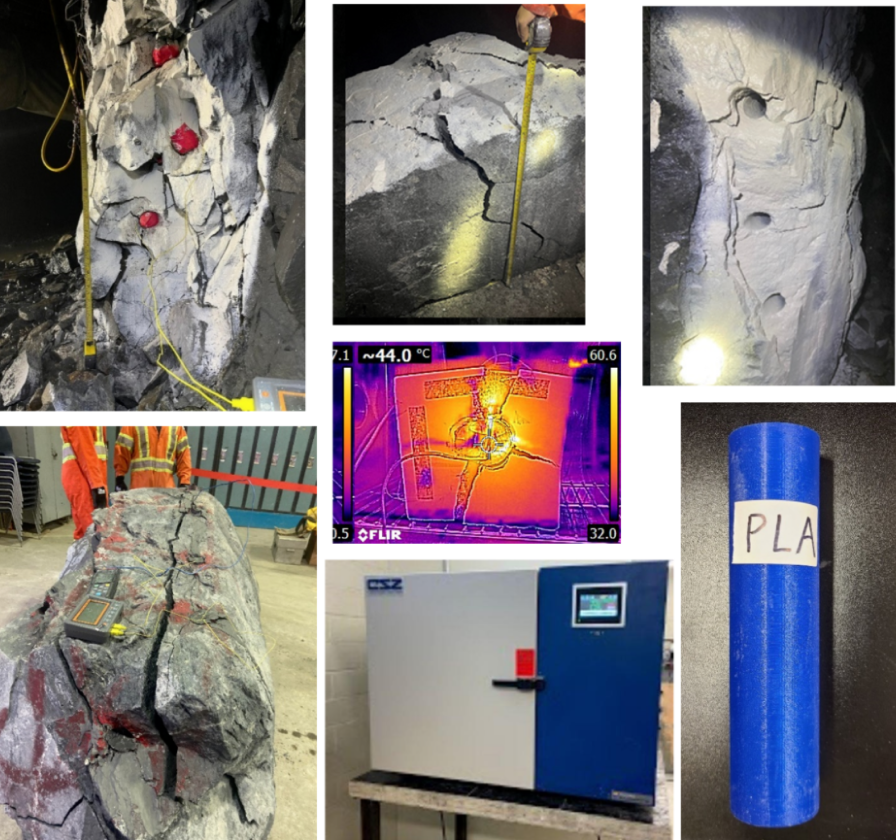
This project aims to develop methods and techniques for the breakage of hard rocks - like granite and norite - without explosives using the so called soundless chemical demolition agents (SCDA), also known as expansive cement. SCDA is a powdery cementitious material that when mixed with water forms a slurry that will expand upon curing. When the SCDA is poured into a borehole in a concrete block, the expansion pressure will eventually break the concrete block. SCDA is commercially available; its most common use in industry is in the demolition of concrete foundations.
The goal of this project is to import and adapt the use of SCDA to break rocks for use in excavations such as tunnels and mines. Breaking rocks without explosives is environmentally friendly as it will avoid the generation of toxic fumes associated with blasting with explosive energy. Besides, blasting causes noise and vibrations, which are not always tolerable in the vicinity of the work area. Blasting requires additional ventilation to exhaust the toxic fumes from the blasted area, and as a result access to the work area is restricted during that period.
On the other hand, expansive cement can be prepared and poured into boreholes without requiring rigorous safety and site access measures. All these factors formed the motivation for this project with the objective to arrive at robust solutions for explosive-free rock breakage.
The first phase of this project, which took place at McGill University Mine Design Lab, focused on the estimation of the maximum pressure generated by the expansive cement and how it is influenced by the borehole geometry and host medium rigidity, i.e., the material of the block to be broken up.
Having succeeded to fracture and break granite blocks, the second phase aimed to break large panels of 1 m x 1 m x 0.25 m thick subjected to planar horizontal and vertical pressures. This experiment mimics the excavation face of any underground opening such as a drift, a ramp, or a tunnel, which are always subjected to vertical and horizontal confinement stresses. A special horizontal loading frame was designed, built, and combined with an existing vertical loading equipment at CANMET Mining labs in Sudbury, Ontario to perform the experiment.
Initially, panels from high strength concrete were tested, then they were followed by tests on panels from granite. Following a series of extensive computer modelling studies and building on the experience gained from breaking small granite blocks in Phase 1, the panel experiments were tested with a variety of borehole patterns and subjected to different confining pressures.
This experiment is the first of its kind and it led to breakthrough discovery that a hard rock mining front can be broken up with SCDA. The third and final phase of this project took place at two mines of Newmont Corporation namely Hoyle Pond Mine in Northern Ontario and Eleonore Mine in Northern Quebec. The goal of Phase 3 was to validate the use of SCDA in the field. At both mines, SCDA was used to demolish rock boulders, and Eleonore Mine, SCDA was used to excavate the corner of an intersection – an operation known as slashing.